Showing posts with label Lincoln Bicentennial. Show all posts

Wednesday, September 2, 2009


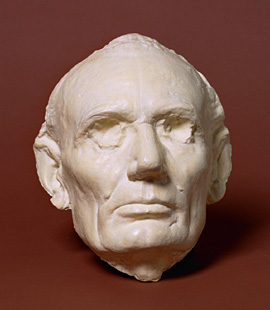
Lincoln Life Mask, by Clark Mills, cast on February 11, 1865

This was a startling object to come face-to-face with (literally!). It is part of the Smithsonian's National Museum of American History Lincoln bicentennial exhibit, Abraham Lincoln: An Extraordinary Life. The exhibit is fantastic: filled with artifacts including Lincoln's personal belongings (such as his top hat, pocket watch & office suit), campaign paraphernalia, and some incredible photographs--you won't find any reproductions here, nothing but genuine articles. I visited this exhibit directly after seeing the new-and-improved Lincoln museum at Ford's Theatre, and it was a great follow-up.

Anyway, the mask above was created from a method known as plaster casting, whereby oil is applied to the subject's face followed by a thin layer of quick drying plaster paste. The sculpter, Clark Mills, used this process to make an exact impression of Lincoln's face just two months before his assasination. I think it's striking to see the actual face of the man, with no artistic liberties taken for vanity's sake, or to cover over the traces of strain and physical toll the presidency had taken on him. Seeing it reminded me that Lincoln is really the first president whose image was realistically documented thanks to the development of photography, a relatively new invention in his time.

This life mask was actually the second one to be made of Lincoln, the first was done in 1860 in Lincoln's home of Springfield by Leonard Volk. Volk wanted to make a bust of him, and so made the mask to use as a reference tool to eliminate the need for Lincoln to return for additional sittings. It's amazing to note the difference between the two, he seems to have aged much more than just five years.

Volk's life mask of Lincoln, done in 1860
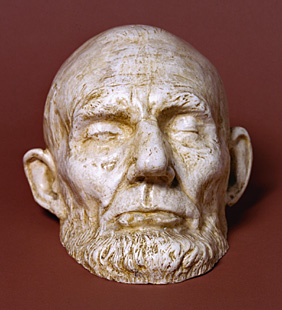
Mill's life m

Tuesday, September 1, 2009

Summer Reading Roundup!


Well, although summer officially goes on for a few more weeks, I have started back into my final semester of grad school--now, as it ever has, it seems summer ends with the beginning of classes. So! That means it's time to take a look back at the books that made it onto my summer reading list, as well as discuss the unexpected, last minute addition...

While perusing the museum shop at the Smithsonian's American History museum, I happened upon the copious pile o' Lincoln books. I couldn't resist owning one of them, and decided on James Swanson's Manhunt (pictured above. Note my ticket stub to Ford's Theatre being used as the bookmark!), which, rumor has it, will be the source material for an upcoming movie adaptation (spoiler alert: Harrison Ford has been associated with the project).

Readers, I was unprepared for how gripping this book would be; it took all of two days (of which I was fully engaged in vacation activities) to get about 200 pages into it. Swanson tells the story in a kind of back-and-forth narrative, describing the unfolding madness of events from the perspectives of both conspirators and manhunters, 369 pages spanning about 12 days--he doesn't waste any of them. My highest recommendation; I'm not sure if it's just because of my Lincoln obsession or if this book really would appeal to anyone, but it is an amazing story told from a balanced point of view. you even catch yourself rooting for Booth in a few places ("No! don't cross the Potomac there! You're not in Virginia yet!"). Go read this book right now, Lincoln fans! Every American should be familiar with the players in this story, and this book fleshes them out better than most.

SO! Now, for the record, here is the official list of Books I Read This Summer in this, the year of our Lord, two thousand and nine:

  • Who Censored Roger Rabbit? by Gary Wolf
  • Post Office by Charles Bukowski
  • The Madness of Mary Lincoln by Jason Emerson
  • Star Trek Academy: Collision Course by William Shatner
  • Mrs. Lincoln: A Life by Catherine Clinton
  • A Walk in the Woods by Bill Bryson
  • Pride and Prejudice and Zombies by Seth Graham-Smith
  • The Long Goodbye by Raymond Chandler
  • Trouble is My Business by Raymond Chandler
  • Mr. Thundermug by Cornelius Medvei
  • Tried By War by James M. McPherson
  • Mailman by J. Robert Lennon
  • Take the Cannoli by Sarah Vowell
  • The Barefoot Mailman by Theodore Pratt
  • Logan's Run by William F. Nolan and George Clayton Johnson
  • Manhunt by James L. Swanson

There she is, folks--a very worthy list of heavy hitters if I ever saw one. You may use it to come to whatever conclusions about my mental state and/or personal character you like...I'm going with "blossoming Lincoln addict with a Postal fasciniation and tendency towards fantastic/tragic visions of the future."

Assassination Vacation


Readers, it's been another while since you've heard news from the Mercy Missiles front, but it could not be helped: I was out in the field, selflessly researching and gathering materials for your information needs/wants! I spent last week in our nation's capitol, and the above firearm--an object at once dainty and ominous--was one of the main attractions.

Pictured above is the ACTUAL Darringer single shot pistol used by John Wilkes Booth to assassinate Abraham Lincoln at Ford's Theatre on the night of April 14th, 1865. Longtime readers may remember that Mary Todd Lincoln is a particular interest of mine, but with all the Lincoln hubbub this year--due to the bicentennial of his birth--I've widened the scope of my obsession to include all things Lincoln.

Ford's Theatre was what I was especially excited about visiting last week: it's been under reconstruction, just recently reopening its downstairs museum last month, and chief among the artifacts was Booth's pistol. It's well worth a visit, even if you are only a casual Lincoln fan, as it is yet another spot in the district where one can view the actual objects used by and belonging to the most notable players in American history. Ours is a young enough country--we sometimes forget--that the most tactile ephemera (the contents of Booth's pockets when he was captured, for instance) survives, and can be experienced (and gawked at!) as a direct link to past events.

I'll be posting more about my trip in the coming days--I was able to pack a lot of historic ogling into one short week (ask me about the day I saw--in person--the flipside of the nickel! W-O-W!)...

Sunday, June 7, 2009

From the Kitchen of Mrs. Lincoln


Like many of you out there in Americaland this year, I have been reading up on our 16th president lately. History was never really my thing (I've never referred to myself as a "buff" of anything), but my recent trip to Washington D.C. and the bicentennial of the birth of The Great Emancipator (or The Railsplitter, as some of his contemporaries called him) has inspired me to do some research on the subject.

Being a good little knee-jerk feminist, I decided to circumnavigate the rather overwhelming mountain of what modern historians call "Lincoln Scholarship" and read about Mary Todd Lincoln (the first wife of a US president to be called the "First Lady"). The much ignored, much maligned Mary Todd is nothing if not a vilified headstrong female, often portrayed as:

1. wildly emotional (Lincoln's White House secretaries nicknamed her The Hellcat, and not in a jovial, friendly kind of way: "hellcat" seems to be the 17th C. version of "crazy bitch"),

2. wack-o (ala her penchant for indulging in public temper tantrums and the infamous post-assassination insanity trial), and

3. selfish (her out of control spending habits and zeal for accumulating massive amounts of material goods—many of which she didn’t need and never used—are legendary).

From what I've read, it seems like all of these assessments are generally true. Having been a personal witness to the perils and symptoms of mental illness, I have to agree that she was indeed suffering from some sort of (probably inherited) psychological condition. Several of Mary’s close relations are known to have suffered severe bouts of mental illness—probably bipolar disorder, according to modern psychologists—and spent significant time in asylums. Add to that the pressure and intense scrutiny of life as the wife of the president of the United States (during a time of intense strife and upheaval), the estrangement of her family (the aristocratic Todd family looked down their noses at Lincoln: the Jeb Clampett of Illinois lawyers, not to mention most Todds sided with the Confederacy), plus the early death of 3 of her 4 children, and it seems amazing that Mary was able to hold it together as well as she did.

Mary is a pretty fascinating woman, and I’ve enjoyed reading about her. Surprisingly, I’ve managed to keep a fairly level head as far as taking sides goes; while I think she has been unfairly treated by most historians (as well as the Washington society and press she tried--and failed--to woo), that doesn’t mean she was some wrongly accused martyr…she was unreasonable, vain, stuck up and, frankly, girlfriend had issues.

And about that cold-hearted Washington society that ended up shunning Mary: would we, the Little People, have much patience for some uppity, hard-to-deal-with, ego-maniacle, blue blood politician's heiress wife with a sense of entitlement these days? We tend to scoff at the Old Money purebreds, swift-boating them all the way back to their elitist Ketchup empires. And if someone gets hurt feelings or shows a little vulnerability, they get shouted down by those who say that this is the life that they have chosen and they should get used to the fact that they are going to be under a microscope. Public figures--and their families--will, and always have been scrutinized for faults. Imagine what that kind of stress would do to someone with bipolar disorder, or even you or I over the long haul.

Anyone wanting to read up on the first First Lady would do well to read Jason Emerson’s The Madness of Mary Lincoln, which examines new documents discovered during the years of Mary’s confinement at Bellevue Place Sanitarium. Catherine Clinton’s recent bio Mrs. Lincoln: A Life is worth reading, but focuses more on Mary’s youth and the White House years, and tends towards the sentimental. I can’t wait for Emerson’s Robert Lincoln bio, due out next year: Giant in the Shadows.