Showing posts with label Washington D.C.. Show all posts

Thursday, February 25, 2010

Mercy Missiles to Attend ALA Annual


Oh, boy, readers--guess who's attending this year's American Library Association Annual Conference in our nation's capitol?! It's me, your humble biblio-correspondent! I just got my official ALA membership card in the mail yesterday and I'll be attending the big show in June with a compatriot, and I have to say--I'm really getting psyched up for it. My MLS degree was conferred to me in December, so I'll be walking into the profession's biggest annual event with the confident swagger of a know-it-all little upstart--I can't wait to see Nancy Pearl wagging her finger disapprovingly at me!

And speaking of celebrities (Nancy Pearl--a "celebrity" in library circles, anyway), I've just been checking out the conference's itinerary and have to admit, I'm getting pretty star struck. The opening general session speaker will be Toni Morrison! W-O-W! My undergraduate American Lit professor (in whose classes I read pretty much everything Morrison has written) would cry tears of joy if she knew I was going to be in the same room with her idol, and I'm pretty giddy at the prospect myself. And also: Art Spiegelman, best known for his graphic novel Maus: A Survivor's Tale, will also be on hand for a program about the value of maintaining comics and graphic novels as a special collection(!)

The only problem I foresee is my lackluster track record dealing with celebrities. I usually mumble something ridiculous/embarrassing, avoid eye contact, and run away after a few awkward seconds. This has been epidemic behavior for me in my past encounters with various rock and roll types (I once found myself in a public restroom with Kathleen Hanna! I defy you to think of a better way to play it cool in this situation than staring at the celebrity in gawking, open-mouthed astonishment. I sure couldn't). Acting like an anti-social weirdo is fine when you're just trying to impress some semi-obscure musician/performer, but I'll really have to step it up if I want to appear well-adjusted in front of a Nobel Prize winner.

More to come!

Sunday, September 13, 2009

Battle of the Wilderness


Readers, I'm winding down my obnoxious parade of Washington D.C. vacay photo essays, I swear. I just wanted to tell you a few things about the Battle of the Wilderness area, which we drove through on our way to Monticello, the home of Thomas Jefferson (also the B-side of our very own 5 cent piece: the fabulous U.S. nickel!).

The battle took place over three days in May, 1864, in the dense forest region of Spotsylvania, Virginia. Lee's army was vastly outnumbered (61,000 Confederates against Grant's 101,000) and had inferior artillery, both of which would be somewhat nullified in the confusing close quarters of the Wilderness, which played host to the most bloody fighting in the most brutal conditions of the war. Accounts vary, but it is generally agreed that the Union lost close to 17,000 men to the Confederacy's 8,000. While Grant's losses were greater and he was the one to disengage from fighting, it was not a true victory for Lee as Grant continued his aggressive offensive on towards Richmond rather than retreating North.

It was in this battle that a Union surgeon, William Chester Minor, saw much of his war action. Along with his (often futile) efforts trying to save the lives of the wounded, Minor was also charged with the duty of punishing those that tried to flee, branding their skin with the letter "D" for deserter. He survived the battle and the war, but in 1868 began exhibiting signs of mental instability. He was institutionalized at St. Elizabeth's hospital, an asylum in Washington D.C., for a year and a half with no improvements to his condition reported. He was then allowed to retire from the army and collect his pension, and in 1871 wandered to a slum in London, where his paranoia led him to fatally gun down a random man in the street.

Minor was found not guilty on grounds of insanity, and committed to Broadmoor asylum. Because he had an income (his army pension) and he was not judged to be dangerous, he was allowed to live in comfortable quarters along with his massive collection of books. It was during this time that he began corresponding with the creators of what was to become the most ambitious attempt to collect and document the English language: the Oxford English Dictionary. England's Philological Society had called for volunteers to help collect notations for words (their definitions and origins), and Minor devoted the rest of his life to the project, compiling over 10,000 entries, becoming the most prolific of the OED volunteers, and in the meantime befriending one of the project leaders, Dr. James Murray (who was, incidentally, unaware of Minor's situation until, believing that Minor was the hospital's administrator, he visited the asylum himself--only to discover his pen pal was an inmate, not its director).

By 1902 Minor's condition began to deteriorate further, his health failed, and he was eventually allowed to return to St. Elizabeth's in Washington, where he was diagnosed with schizophrenia. He died in 1920.

Monday, September 7, 2009

The Library of All Libraries!


That's right, readers, last week in DC I made sure to visit the nation's oldest federal cultural institution, established by John Adams in 1800: the Library of Congress! It was my first time inside the largest library in the world, and I was not disappointed: housing more than 130 million items, it is ensconced in marble, gold leaf, intricate mosaics, murals, mahogany paneled rooms and sculpture. We took a tour with a very well informed docent, and he spared no details: the tour lasted for about an hour and a half, and it was really a highlight of the entire trip.

But the thing that really got me keyed up about my LOC visit? That would be my brand new Library of Congress Registered Reader Card! I can now use the great reading room (as seen in National Treasure 2: Book of Secrets) anytime I want, which I am already planning on doing my next time in the district. Not sure what I'll be researching, but who cares? I'll be using the same library that Congress uses! W-O-W! You just show your card, go in, ask one of the reference librarians on duty for the book(s) you want (theft has made necessary the policy of closed stacks), and then pick out an empty desk in the crazy opulent main reading room...I can't wait!

Saturday, September 5, 2009

Gettysburg


While I was in the District last week, we decided to make the hour or so drive to Gettysburg to see the famous battle sight there. Besides Perryville, Kentucky, I had never visited a Civil War battlefield--and of course Gettysburg is the most notable, it being the turning point of the war for the Union, and the backdrop for Lincoln's most famous address.

The town is kind of a quaint, throw-back little square of old brick buildings, with informative little markers in every nook and cranny. Still somewhat thriving, Gettysburg has a small-ish liberal arts college (founded in 1832) that boasts Dwight D. Eisenhower as a former member of its board of trustees. It's definitely one of those "cute historic towns" that they pack with jaunty public flower beds and bed and breakfasts, existing as near-stage setting for the tourists who come to see all the old cannons, monuments and graves scattered about. And speaking of graves: the other notable thing about the town of Gettysburg? Ghost tours. LOTS of ghost tours. Gettysburg has ghost tours like Myrtle Beach has putt putt courses: there's one on every corner.

Anyway, it was pretty impressive out in the field. Aside from seeing big marble monuments rising up every so often (erected by the states who had troops involved in the battle, along with others honoring various regiments), you get the distinct impression that the landscape really hasn't changed much since 1863. There's still the sprawling countryside, low walls built of brick and wood, and the view of the Blue Ridge Mountains off in the distance. The National Parks service maintains the area, including the graveyard on Cemetery Hill, which is where Lincoln delivered the Gettysburg address after the massive burial of over 28,000 soldiers.

One other highlight from the trip was our tour guide at Cemetery Hill: he was spectacularly terrible. The guy was a summer intern for the Parks Service, and he had a peculiar way with adjectives: that is, he ruthlessly abused them, which had a sort of breathlessly redundant, hypnotizing effect. You would want to turn away, but being stunned by his relentless beat-down of the English language, your senses were dulled into submission. He would also randomly interrupt himself to make disdainful interjections about what he saw people doing off in the distance. This confusing blend of historical and social commentary was pretty jarring: "...and that's why you see many numerous amounts of graves with--can you believe that lady's letting her kid do that??" Wha-huh? The entire group would all turn around.

This may sound nit picky, but it was a rather long tour, and this notably bad habit of his was combined with a tendency to talk so rapidly (or, as he would say "quick and rapid and really really fast, you guys") he would run out of breath, leaving him to pant his way through his speech. It was exhausting to witness. I wanted to run away, but the strange ranger-wannabe wizard held us all spell-bound. His take on the battle of Gettysburg was that it was "really really [gasp] REALLY bad and [wheeze] not good. You can't even [gasp] imagine it. REALLY, you can't--does that guy think he can park here??"

Thursday, September 3, 2009

An Exhibit with "Pond-like Proportions"


The National Archives is celebrating its 75th anniversary this year, and in honor of the event has put together a rather, um, notable collection of artifacts for an exhibit they are calling "Big!" Included, for instance, is a 16-inch-long size 22 sneaker belonging to Shaq(!), and a stitched-together parchment that was the first official copy of the 1777 Articles of Confederation that measures 13 feet and 5 inches long. The fact that these two objects don't belong in the same room is not a subject that is brooched in the exhibition...standing in the middle of even more objects of contradictory purpose and meaning (and signifigance and importance and etc. etc. etc.) you can't help but feel like somehow there's a joke you are failing to get.

Anyway, I wanted to visit the archives for the same reason most people do: to run speedwalk directly to the rotunda and gawk at the Declaration of Independence, U.S. Constitution and the Bill of Rights (although the Magna Carta was an unexpected bonus!). I was geeking out, shoving myself elbow-to-elbow with all the other tourists who couldn't help themselves from snapping away with their non-flash camera phones in the archival-friendly low light. (hint: taking pictures of documents in low light under thick glass at an odd angle makes for a crappy picture)

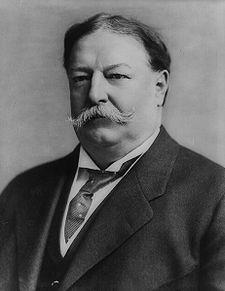
Once I was able to pull myself together, I realized there were other, better lit things to see in this place. Notably (and I guess this is really just too appropriate for an exhibit called "BIG!") there was president Taft's infamous, 7-foot-1-inch-long custom made bath tub. The information card mentions that people at the time proclaimed it to be of "pond-like dimensions." At 340 pounds and 6 feet tall, the president certainly did stand out among his contemporaries, and it seems that everyone was eager to vocalize that point, making fat jokes and taking special note of the way Taft would "struggle for breath at every step," and how he "seemed mentally dull after large meals." Awww, doesn't Taft sound adorable? Sorta like some blustery, narcoleptic cartoon walrus who could influence policy.

Wednesday, September 2, 2009


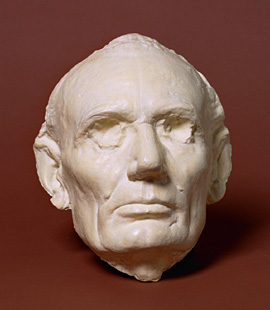
Lincoln Life Mask, by Clark Mills, cast on February 11, 1865

This was a startling object to come face-to-face with (literally!). It is part of the Smithsonian's National Museum of American History Lincoln bicentennial exhibit, Abraham Lincoln: An Extraordinary Life. The exhibit is fantastic: filled with artifacts including Lincoln's personal belongings (such as his top hat, pocket watch & office suit), campaign paraphernalia, and some incredible photographs--you won't find any reproductions here, nothing but genuine articles. I visited this exhibit directly after seeing the new-and-improved Lincoln museum at Ford's Theatre, and it was a great follow-up.

Anyway, the mask above was created from a method known as plaster casting, whereby oil is applied to the subject's face followed by a thin layer of quick drying plaster paste. The sculpter, Clark Mills, used this process to make an exact impression of Lincoln's face just two months before his assasination. I think it's striking to see the actual face of the man, with no artistic liberties taken for vanity's sake, or to cover over the traces of strain and physical toll the presidency had taken on him. Seeing it reminded me that Lincoln is really the first president whose image was realistically documented thanks to the development of photography, a relatively new invention in his time.

This life mask was actually the second one to be made of Lincoln, the first was done in 1860 in Lincoln's home of Springfield by Leonard Volk. Volk wanted to make a bust of him, and so made the mask to use as a reference tool to eliminate the need for Lincoln to return for additional sittings. It's amazing to note the difference between the two, he seems to have aged much more than just five years.

Volk's life mask of Lincoln, done in 1860
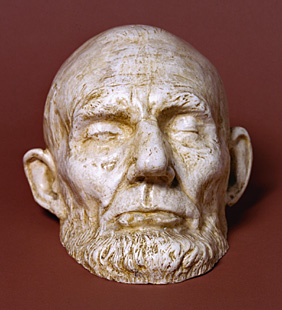
Mill's life m

Tuesday, September 1, 2009

Summer Reading Roundup!


Well, although summer officially goes on for a few more weeks, I have started back into my final semester of grad school--now, as it ever has, it seems summer ends with the beginning of classes. So! That means it's time to take a look back at the books that made it onto my summer reading list, as well as discuss the unexpected, last minute addition...

While perusing the museum shop at the Smithsonian's American History museum, I happened upon the copious pile o' Lincoln books. I couldn't resist owning one of them, and decided on James Swanson's Manhunt (pictured above. Note my ticket stub to Ford's Theatre being used as the bookmark!), which, rumor has it, will be the source material for an upcoming movie adaptation (spoiler alert: Harrison Ford has been associated with the project).

Readers, I was unprepared for how gripping this book would be; it took all of two days (of which I was fully engaged in vacation activities) to get about 200 pages into it. Swanson tells the story in a kind of back-and-forth narrative, describing the unfolding madness of events from the perspectives of both conspirators and manhunters, 369 pages spanning about 12 days--he doesn't waste any of them. My highest recommendation; I'm not sure if it's just because of my Lincoln obsession or if this book really would appeal to anyone, but it is an amazing story told from a balanced point of view. you even catch yourself rooting for Booth in a few places ("No! don't cross the Potomac there! You're not in Virginia yet!"). Go read this book right now, Lincoln fans! Every American should be familiar with the players in this story, and this book fleshes them out better than most.

SO! Now, for the record, here is the official list of Books I Read This Summer in this, the year of our Lord, two thousand and nine:

  • Who Censored Roger Rabbit? by Gary Wolf
  • Post Office by Charles Bukowski
  • The Madness of Mary Lincoln by Jason Emerson
  • Star Trek Academy: Collision Course by William Shatner
  • Mrs. Lincoln: A Life by Catherine Clinton
  • A Walk in the Woods by Bill Bryson
  • Pride and Prejudice and Zombies by Seth Graham-Smith
  • The Long Goodbye by Raymond Chandler
  • Trouble is My Business by Raymond Chandler
  • Mr. Thundermug by Cornelius Medvei
  • Tried By War by James M. McPherson
  • Mailman by J. Robert Lennon
  • Take the Cannoli by Sarah Vowell
  • The Barefoot Mailman by Theodore Pratt
  • Logan's Run by William F. Nolan and George Clayton Johnson
  • Manhunt by James L. Swanson

There she is, folks--a very worthy list of heavy hitters if I ever saw one. You may use it to come to whatever conclusions about my mental state and/or personal character you like...I'm going with "blossoming Lincoln addict with a Postal fasciniation and tendency towards fantastic/tragic visions of the future."

Assassination Vacation


Readers, it's been another while since you've heard news from the Mercy Missiles front, but it could not be helped: I was out in the field, selflessly researching and gathering materials for your information needs/wants! I spent last week in our nation's capitol, and the above firearm--an object at once dainty and ominous--was one of the main attractions.

Pictured above is the ACTUAL Darringer single shot pistol used by John Wilkes Booth to assassinate Abraham Lincoln at Ford's Theatre on the night of April 14th, 1865. Longtime readers may remember that Mary Todd Lincoln is a particular interest of mine, but with all the Lincoln hubbub this year--due to the bicentennial of his birth--I've widened the scope of my obsession to include all things Lincoln.

Ford's Theatre was what I was especially excited about visiting last week: it's been under reconstruction, just recently reopening its downstairs museum last month, and chief among the artifacts was Booth's pistol. It's well worth a visit, even if you are only a casual Lincoln fan, as it is yet another spot in the district where one can view the actual objects used by and belonging to the most notable players in American history. Ours is a young enough country--we sometimes forget--that the most tactile ephemera (the contents of Booth's pockets when he was captured, for instance) survives, and can be experienced (and gawked at!) as a direct link to past events.

I'll be posting more about my trip in the coming days--I was able to pack a lot of historic ogling into one short week (ask me about the day I saw--in person--the flipside of the nickel! W-O-W!)...